
90

Rome’s Purgatory Museum: A November Pilgrimage

(Last time, I promised to follow up Ad Rem 89 with some concrete advice. This will come, God willing, but first something more timely for November.)

Fingerprints burned into a prayer book. A clearly visible charred hand print on a wooden table. Similar marks on shirt sleeves, a night cap, and aprons. These are among the curiosities to be seen in Rome’s Purgatory Museum.

by Brother André Marie November 15th, 2008

Abortion Opposed From Heaven


John F. McManus

When Speaker of the House Nancy Pelosi appeared on Meet the Press a few weeks ago, she was asked about her consistent approval of abortion. Repeating her frequently stated stand, she insisted that she is “an ardent, practicing Catholic” and then claimed that no one knows when life begins. Moderator Tom Brokaw promptly told her [...]

An Interview with Myself


Brother André Marie

Today, the Feast of the Dedication of the Basilicas of Saints Peter and Paul, there is an interview with me published on the Renew America web site. Brian Mershon, a traditional Catholic journalist interviewed me several months ago, and this is the result:
One year later…the forgotten document: A reaffirmation of the one true Church of [...]

Remember: The Holy Souls Need Your Prayers


Christine Bryan

Every evening we come before our Blessed Mother, bringing her a collection of our day’s efforts. She gracefully produces a gift of value and, in November, we are emboldened to ask if any of it could be applied to the Holy Souls in Purgatory.
November is the month dedicated to the Holy Souls, and they are [...]

The Boston Pilot's Great Fenian Editor John Boyle O'Reilly


Brian Kelly

One of the earliest and most popular editors of the Catholic newspaper, The Boston Pilot, was an escaped “convict.” John Boyle O’Reilly (1844-90) was unjustly sentenced in 1867, by the English, to twenty-three years of penal servitude in Australia for his anti-British activism as a member of the Irish Fenians. He escaped the [...]

Blue is for Purity


Brian Kelly

In Catholic religious art the color blue, not white, is symbolic of purity. The white wedding gown originated in the nineteenth century in imitation of Queen Victoria who wore white for her wedding to Prince Albert. The blue that brides were instructed to wear “something borrowed, something blue” on the wedding day was in honor [...]

The Capuchin Cemetery: (Catholic) Faces of Death


Brother André Marie

I’m back from this two-week trip to Rome, but I haven’t gotten the Eternal City out of my mind. Not by a long shot. Thus, this entry, which has a ghoulish picture in it. I think it’s an appropriate meditation on death for November.
In Rome there is a famous church dedicated to the Immaculate Conception, [...]

Boston College Sinks to New Levels of Depravity


Joe Doyle

The following is a press release from the Catholic Action League, condemning a deal between Boston College and Victoria’s Secret:
The Catholic Action League of Massachusetts today criticized Jesuit administered Boston College for entering into a business relationship with Victoria’s Secret, the self-described distributor of the “world’s sexiest brands” in women’s lingerie, sleepwear [...]

What Was the First Diocese Established in North America?


Brian Kelly

The first diocese established in North America was not Mexico City or Quebec but Greenland. Viking Leif Erikson, son of Erik the Red, brought along Catholic missionaries when he sailed to Greenland from Norway in the year 1000. His father, exiled from Norway, had established a colony there in 986 at Brattahlid. Leif was raised [...]

Saunter: A Word With an Interesting History


Brian Kelly

The word “saunter,” which means to “wander about,” is derived from Saint Terre (Holy Land). The connection is this: After the age of the catacombs, with the ascent of Constantine and Theodosius to the imperial Roman throne, Christians were free to make pilgrimages to Palestine. This was always a dangerous journey, especially after the seventh [...]

Pius XII Saw Miracle of the Sun Four Times


Brian Kelly

Zenit News has a very interesting article affirming the fact, with documentation, that Pius XII saw the sun dance in the sky and change colors four times, October 30, 31, November 1, and November 8, 1950. He defined the dogma of Our Lady’s Assumption on November 1 that year. The pope testified to this in [...]

Resources
Affiliated Sites
News Headlines

God Is Not Catholic, Cardinal's Word of Honor

Melbourne Doctor Says Most Donors Still Alive When Donating Organs

Italian Court Orders Hospice Run by Nuns to Euthanize Patient

The American Humanist Association vs. God

Maryknoll Priest to be Excommunicated

Boston College Sinks to New Levels of Depravity

No Communion If You Voted for Obama Priest Tells Parishioners

Several Bishops Vow No Compromise in Abortion Fight

Opponents of Proposition 8 Threaten Pro-Family Advocates

Catholic Colleges Helped Obama Win

Al Qaeda Puts 60 Million Bounty on Coptic Priest

Pius XII Saw Miracle of the Sun Four Times

Marriage is a Union Between One Man and One Woman, Except in Massachusetts and Connecticut and California Between June and November 2008

Washington State Legalizes Assisted Suicide

54% of Catholic Voters Voted for Obama

Catholic Leaders Congratulate Obama

In the Final Hour Not a Few U.S. Bishops Gave Warning

Xavier University in Cincinnati Hosts Pro-Obama Event

USCCB Has Been Donating Millions to ACORN

Thanks for Clearing That Up

Cardinal Prefect Reiterates No Homosexuals Can be Ordained to Priesthood

Seek the Wisdom that is the Mind of Christ

U.S. Ambassador to Vatican Addresses Secularism in Vatican Paper

Bishop of Scranton, PA, Warns About Bogus "Catholic" Groups

Two Jesuit Priests Murdered in Moscow

Moslem Convert Corrects Cardinal: Violence Is the "Fruit" of the Koran

Actor Eduardo Verastegui Gives the McCains Miraculous Medals

Synod Omits Heterodox Statement on Inerrancy: CDF to Decide

Iraqi Christians Continue Exodus

Pope Benedict Addresses Chinese Bishops Denied Exit Visas

American "Catholic Culture" and the Internet Age

Viva Grucci! Fireworks Giant Makes a Booming Defense of Christmas

Americans United Petitions IRS to Investigate Catholic Bishops

Vatican Officials Express Indignation over Israel's "Interference" with Beatification of Pius XII

Retired Bishop in Radio Ad Against Obama

More on Bishop Martino's Confrontation with Parish Forum

The Catholic America Tour Has Begun

Bishop Martino: "This is Madness People"

Jesuit University Honors Pro-Abortion Leon Panetta

Thanks Marjorie

Br. Francis Maluf, M.I.C.M.

Is Bible Reading Safe?

Print Subscribe
by Br. Francis Maluf, M.I.C.M.  February 02nd, 2008

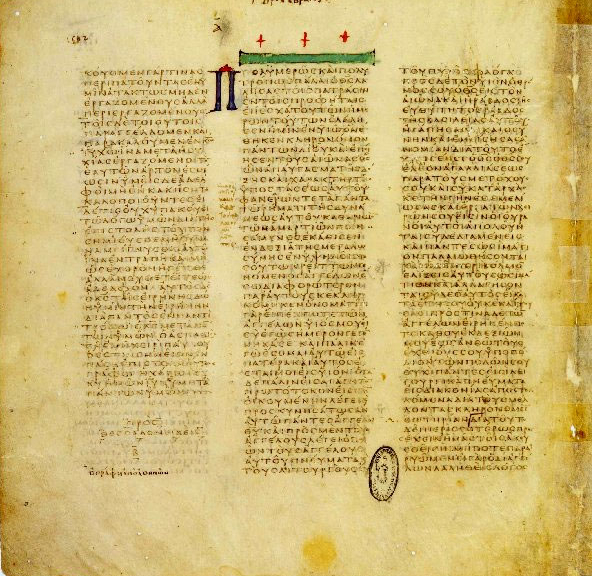
We often hear the question asked, sometimes even by the well-instructed: “Is it safe to read the Bible?” The answer, of course, is: “Yes, certainly; the Church blesses and encourages the habitual reading of Holy Scripture by all the faithful.” Still, however, the question reveals certain worries in the minds of Catholics that should not be dismissed lightly. For while meditation on the Word of God could be said to have made all the saints, it is also quite true that the mis use of Scripture is responsible for all heresies.

Catholics, Protestants, and Jews, all somehow claim to live by the Bible; but how few are they who do so in fact! Consider the Holy Bible in its two Testaments as revealed by the Holy Ghost, essentially differing only according to whether they were written before or after the coming of Jesus. The only purpose of the Old Testament is to foretell that coming of a Saviour and to show how the whole world was being prepared for His work of redemption. The principal message of the New Testament is the continued presence of Christ with us in His Church. To use the Bible correctly, therefore, and in accordance with the purpose for which it was given, the Old Testament ought logically to lead to faith in Jesus; the New Testament ought to bring one to the true Church; and the Church and her Sacraments ought to lead to sanctity. Yet the Jews refuse to take the first step, Protestants refuse to take the second, and God knows how few are the Catholics who take the third.

And so it is that, as in the case of all other great gifts of God, we men manifest the evil genius of our fallen nature, especially in the way we make bad use of the Bible. St. Peter warned of this danger, when he spoke of men who “wrest the Scriptures to their own damnation” (II Pet. 3:16).

With that caution in mind, let us cite two hazards or difficulties facing anyone who undertakes the study of the Holy Scripture. First, there are now versions of the Bible — some even published under Catholic auspices — which are in fact distortions and falsifications of the Word of God. Second, there is a great and growing body of literature about the Bible (apparently due to an obsessive preoccupation with God’s Book, even where faith in God is altogether missing), and the great part of such literature proves to be in the nature of snares or distractions. It is a snare when it insinuates and inculcates false philosophies such as are now in vogue. It is a distraction when it manages to keep the mind of the reader (as well as the writer) fixed on all kinds of curious interests, always somehow short of the all-important one of salvation.

So the wary layman understandably is more inclined to follow the prudent counsel given to a tourist in the Alps: “What is the safest way to climb the Matterhorn?” asked the tourist. And the mountain climber replied, “Stay away from it!”

But can we, as Catholics, stay away from the Bible? In an apparition to Saint Teresa of Avila, Our Lord Himself told her that all the evils in the world, and especially all the troubles in the Church, are due to ignorance or contempt of Holy Writ.

Besides, the Bible is our Book; its message is our message; its visible monument in the world is our Holy Church. It is on the authority of our Church, the Holy Roman Church, that we know, or, for that matter, that anyone knows, what writings are inspired by God. Ours is the Church that has preserved Sacred Scripture through the centuries, being the only one that is coeval with it. Ours are the scholars and doctors who guarded its integrity. Ours are the saints who brought its message to life in their lives. And ours are the martyrs who confirmed its divine authority by their blood.

It will therefore be ours to encourage and to cultivate, by means of this column in each issue of the Housetops , the proper and habitual study of Holy Writ. We must recover our Bibles from their graves of dust and bring them back to life. For in this work we will become imitators of the saints — our heroic brothers and sisters in the Faith of all Catholic ages.

For the moment, let us simply offer these few fundamental and practical suggestions as guidelines to this endeavor: A Catholic who would acquire the daily habit of reading the Word of God must do it as a child of Faith. He must seek to understand the Scriptures as Our Lady and Saint Joseph understood them. He must be guided by the infallible teaching of the Church. He must be sure to use a truly Catholic version, supplying help on difficult passages from the insight and knowledge of the saints. (The best version in English is still the Douay-Rheims, translated by English scholars exiled on the Continent during the Elizabethan persecutions.) And he must also remember that the best commentary on Scripture is Holy Scripture itself (as when the New Testament explains the Old) and the use made of Scripture in the traditional liturgy of the Church.

As a final thought, Holy Church, like a Mother, blesses the study of Sacred Scripture with and indulgence. We find it in The Raccolta, the official compendium of Catholic prayers and devotions, under Number 645:

“The faithful who spend at least a quarter of an hour in reading Holy Scripture with the great reverence due the Word of God and after the manner of spiritual reading, may gain an indulgence of three hundred days.” (The new Handbook of Indulgences says this, giving a more generous indulgence: “A partial indulgence is granted the Christian faithful who read sacred Scripture with the veneration due God’s word and as a form of spiritual reading. The indulgence will be a plenary one when such reading is done for at least one-half hour [provided the other conditions are met].”)

This was granted by Pope Leo XIII on the Feast of Saint Lucy, December 13,1898. Let us thank the Patroness of eyes, that sweet virgin martyr, who on her own Feast day obtained for us this favor — a blessing, as it were, for the most beautiful use to which we can apply our eyes.
Print Subscribe
http://catholicism.org/wp-content/plugins/sociofluid/images/facebook_48.png http://catholicism.org/wp-content/plugins/sociofluid/images/digg_48.png http://catholicism.org/wp-content/plugins/sociofluid/images/reddit_48.png http://catholicism.org/wp-content/plugins/sociofluid/images/dzone_48.png http://catholicism.org/wp-content/plugins/sociofluid/images/stumbleupon_48.png http://catholicism.org/wp-content/plugins/sociofluid/images/delicious_48.png http://catholicism.org/wp-content/plugins/sociofluid/images/blinklist_48.png http://catholicism.org/wp-content/plugins/sociofluid/images/blogmarks_48.png http://catholicism.org/wp-content/plugins/sociofluid/images/furl_48.png http://catholicism.org/wp-content/plugins/sociofluid/images/newsvine_48.png http://catholicism.org/wp-content/plugins/sociofluid/images/technorati_48.png http://catholicism.org/wp-content/plugins/sociofluid/images/magnolia_48.png http://catholicism.org/wp-content/plugins/sociofluid/images/google_48.png http://catholicism.org/wp-content/plugins/sociofluid/images/myspace_48.png http://catholicism.org/wp-content/plugins/sociofluid/images/yahoobuzz_48.png
1 Star2 Stars3 Stars4 Stars5 Stars (No Ratings Yet)
Loading ... Loading ...

Leave a Reply
